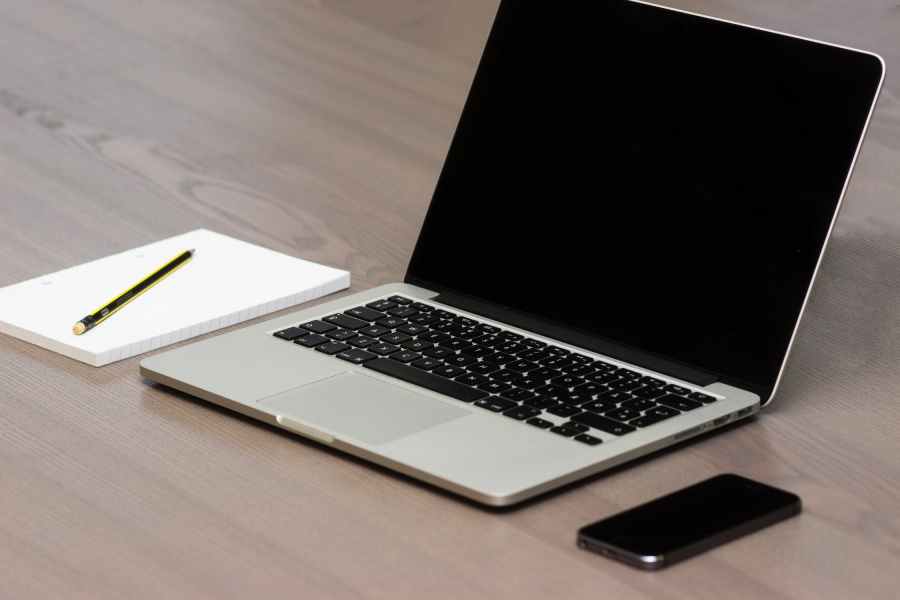
Equally the computer hardware industry evolves so, besides, have the terms to describe the broad variety of computer products. You may be wondering if your personal estimator a laptop or a notebook? The answer is that they are not the same affair. There are differences. Generally speaking, portable notebook computers are viewed as smaller, lighter versions of the larger laptops. However, in that location are more differences to this. Allow'due south explore them in greater detail.
Background and History
To sympathize the differences between laptops and notebooks, information technology's important to know some of the history behind both. Most computer historians point to the Osborne 1 (1981) from Osborne Computer Corp. as the showtime personal computer designed to be portable. At 24 pounds, calling it "portable" was truly a stretch. Nonetheless, it did include a small screen, bombardment pack, floppy drives, and arranged software. Just the estimator never gained traction with the public. Two years later, Radio Shack came out with a much lighter (4 pounds) portable version of its Model 3 computer that nearly closely resembled a modern laptop equally we know them today.
The first known notebook reckoner was released by NEC in 1988, followed a yr afterwards portable, by Apple with its Macintosh Portable, which afterwards evolved into the PowerBook.
P ortability
What makes today's laptops and notebooks desirable is the ability to carry them and use them anywhere. Laptops are portable only come with a heavier battery, larger screens (10 to 18 inches), and more than hardware within like a CD/DVD drive. That makes them generally weigh between 5 to 10 pounds. Notebooks tend to have smaller overall dimensions for both screens and keyboards, making them slimmer to carry and concord, and a full general weight of less than v pounds. This size is preferred by students and consumers who only practice light Internet use or computing. DVD drives are ordinarily not found on notebooks.
F eatures
Many reckoner users know that laptops incorporate more features than notebooks. A few of the laptop's basic features include:
- Full keyboard
- Powerful fundamental processing unit (CPU) and cooling system
- Longer life battery
- DVD/CD drive
- Higher Video Graphics Array (VGA) screen
In contrast, in substitution for its smaller size and lighter weight, the notebook'due south bones features are:
- Thinner than boilerplate laptops
- Lighter weight than laptops
- Enough ability to do basic calculating tasks
- Enough battery power
- Lower costs than average laptops
Cost
Notebooks, especially Google's Chromebook series, have dropped dramatically in cost during the past few years. You tin certainly find an operational Chromebook notebook for less than $150 in 2020. Windows laptops, for case, are increasingly more expensive, ofttimes running $500 and up for a higher-cease laptop. This is why notebooks are enjoying a surge in popularity among students, seniors, and others. Costs are lower, portability is high, and the amount of functional computing is enough for almost users.
U ser Need
The divergence in notebooks and laptops usually comes down to differences in toll, portability, and features. It's up to the user to know what is needed in a personal estimator and what type of work for which it will be used. Knowing the particular needs will assist to determine the level of laptop or notebook will exist enough figurer for i's uses.
DOWNLOAD HERE
Posted by: allenabecaut.blogspot.com


0 Comments