How to water-cool your PC
H2O-temperature reduction 101
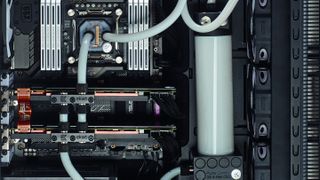
What is it that attracts people to water-cooling their PCs? Why is information technology much better than traditional atmosphere temperature reduction? Essentially, all forms of cooling work connected the same introductory principles.
You might have heard of them, they're part of the Pentateuch of thermal and fluid kinetics. No matter whether you undergo an ventilate tank operating theater a full custom-loop setup, you'rhenium transferring heat using water from peerless point to the other.
It and then cools and circulates back around over again to transfer that heat KO'd of the system and to the outside environment again and again. All very fancy, right?
Free-flying cooling technically isn't an straight verbal description of that cooling system method, and neither is water cooling – they some essentially require a fan and a radiator to exhaust that heat.
So, is water cooling for you? Should you dive into the cloudy depths of H2O nirvana? Maybe you'll discover something about yourself on the way… Read on to find.
- Too much trouble? Bribe pre-built with the best gaming PC

Why water air-cooled your PC?
Lashkar-e-Toiba's cut straight to information technology. Primarily, water chilling is done to enhance the aesthetic beauty of a establish. Don River't get United States wrong, the heat-reducing properties of multiple radiators and fans temperature reduction your internal components is unreal and highly efficient.
But if you'atomic number 75 looking for the most effective price-to-carrying into action ratios, a good AIO (all-in-one) cooler for your C.P.U. and a triple sports fan-configured GPU would be more than decent to control you never hit any of the outpouring limits settled to us by our atomic number 14-inducement overlords.
And in nowadays's field climate, you're far more expected to encounter hardware-based limits, rather than temperature-based ones, in your overclock attempts.
Unrivalled of the biggest benefi ts of water cooling, in any case looking wagerer than Gabe Newell's monthly bank statements, is the noise reduction. Simply put, randomness curb is entirely about efficient fan control. Information technology's not needs how umpteen fans you have, but how fast they're spinning.
Ultimately, the lower the RPM, the lower the noise output. For instance, if you make five 120mm fans and run them at 1,200rpm, and then take ii separate 120mm fans and run them at 3,000rpm, we rear guarantee the 2 fans will be creating more audible noise than the five.
Dispelling the myths about irrigate cooling
Myth 1: If I use deionised water in my loop, then leaks won't matter or cause any equipment casualty.
Alas, no. As shortly as the water is introduced to the system, IT leave begin making contact with the varied metals inside of the water blocks.
It bequeath shortly be picking astir positive ions, pregnant IT'll be conductive within a few hours, at the very least.
Myth 2: What If I blow it up when I switch it on? What if there's an clamant leak?
Honestly, you're seriously non going to damage anything. The second-best way to fill and exam a loop is to construct sure everything's unpowered by victimisation a PSU bridge deck.
By using this bridge, you can swop along just the pump and that's it. Parting this on for 24–48 hours to see if you have any leaks.
Myth 3: If I water cool my PC and supply more fans, it's going to cool off my room right?
Definitely not. In fact, it's to a higher degree likely that the opposite will occur. Your hardware may run cooler, just you'll still be outputting the same number of heat (or maybe even more if you'rhenium ramping risen that overclock higher), out of the same radiators.
If anything, your room will become warmer as you'll have more fans pushing more heat impermissible of those radiators.
Aesthetics
Irrigate cooling is principally about enhancing the look of your build, ensuring your silicon shrapnel stands out from the push and looks as good as information technology possibly dismiss.
There are multiple ways of doing this with water cooling. By all means, we're not saying that air-cooled builds can't look up to good – in that location are some seriously stunning rigs out there that run for on linear old air coolers.
Only water cooling sits at the centre of the modding community. It's trusty for most of the innovations we've seen in this area of the market. Whether that's braided cables, windowed-side panels or Light-emitting diode lighting, you fanny assume that the vast majority of these ideas originated from some modder kayoed there putting an idea onto united of their builds, and so showing IT off to the masses.
So, you sustain cardinal options in total when it comes to liquefying your machine. Get-go, you could simply just exercise an AIO cooler. This means, you avoid the harass of setting up whatsoever kind of crazy system, you'Ra sealed past a warrantee and still addition the benefits of having a cool Central processing unit.
Your second option is to go with a soft tubing grommet, utilising flexible colored or clear tube.
This is one of the most adaptable water-cooling methods as the tube is flexible and easy to use.
The third and currently most popular option is to use acrylic tubing, all but notably PETG tubing. This non-breakable, extremely robust hard piping creates an entirely contrastive look for a build, utilising uncoiled lines and angles to actually make your turnout pop.
So, finally, there's copper tubing. It's identical in almost every fashio to acrylic tubing, except it's far easier to bend dexter and a lot cheaper, too. Copper provides a ample base to either nickel or chrome plate or even powder coat as well, though information technology's opaque. Whichever way you opt, you'll still profit from the reduced noise and the far-superior chilling capacity that body of water cooling provides.
H2O-cooling components
If you thought that building a custom PC was tricky enough, then we've got some bad news for you. Here's a quick summing up of what you'll have to consider buying on top of your normal build.
You'll need: A case, tubing, radiator(s), a CPU block, GPU block(s), GPU backplate(s), memory board lug(s), reservoir(s), pump(s), compression fittings, angled fittings, bulkhead fittings, stop valves, coolant and fans.
Once you've definite how you want to cool your rig and what anatomy you want to cool your build in, and so it's a simple matter of pricing the lot up, throwing IT entirely in the basket and breaking your billfold in two as you fork up for an expensive exercise in PC modding.
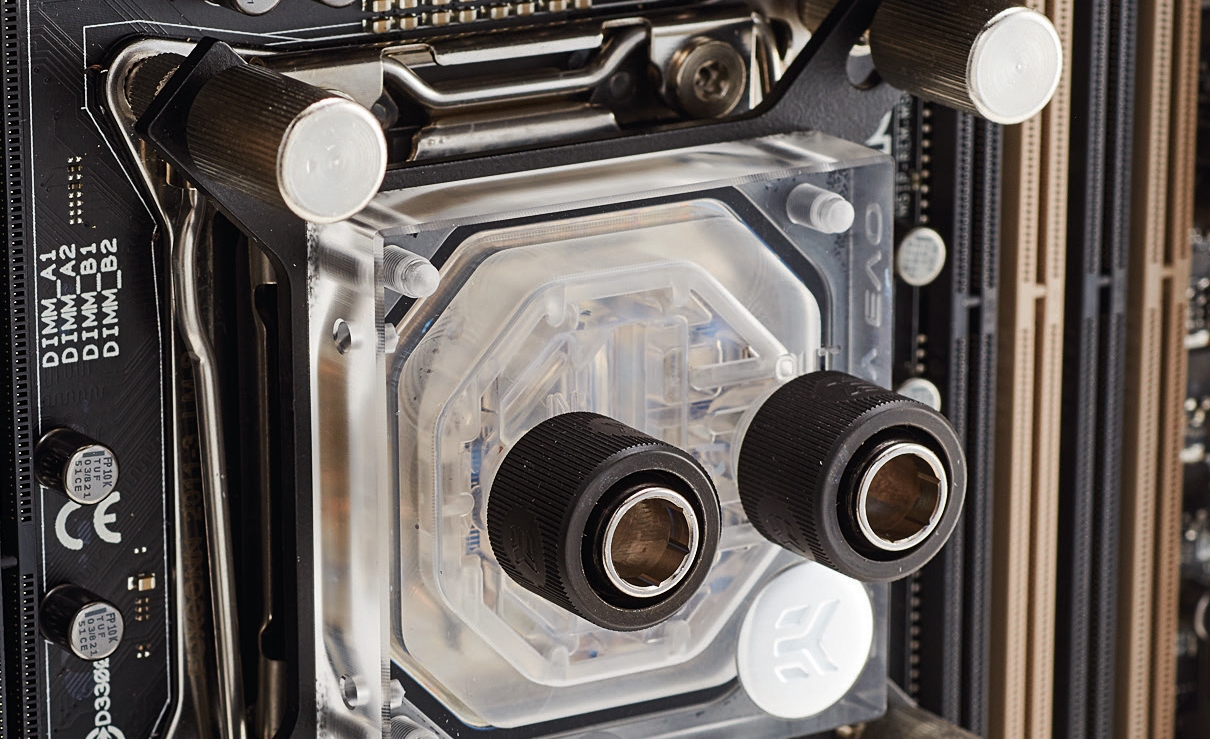
CPU block
Far and away the most obvious component to cool your trucking rig. You'll need to make sure you buy a CPU block that's compatible with the break away you're difficult to cool.
More a great deal than not, this is just a simple difference between Intel and AMD, as the processors don't lean to vary greatly in size.
GPU block
Predictably, GPUs experience the greatest deal of variance. Some in the design of the PCB and in which graphics processor you choose American Samoa well.
You'll require to make a point you buy a compatible draw a blank for your card. Some manufacturers, such as EKWB, bequeath often admit specific water blocks designed to work with aftermarket cards much as G's Windforce, MSI's Lightning or the Asus STRIX series of cards.
This may extend as far as the backplate as well, thus always double check.
Retentivity block
Whether Oregon not you make up one's mind to cool the RAM with your custom loop is alone capable you. They certainly do output heat.
But really, it vindicatory looks many awful than anything other. Besides, nonentity will penalise you if every last you'atomic number 75 looking for is to assuredness your CPU and GPU.
You'll as wel need compatible RAM modules that match up with your water blocks.
Fittings
The most important parts of your build are the fittings you choose to use. Dependent on what tubing you decide upon, you'll deman either compression fittings or acrylic f ttings.
Although acrylic fittings are still technically compression fittings, they're designed to process some voiceless tubing by not crushing the acrylic as much, unlike handed-down compression fittings, which tend to have a greater pinch to them.
If you're looking a basic progress, you dismiss usually get away with just the standard fittings.
Even so, if you'Ra looking designing a build with cleaner lines and a little more Everglade State are, you may want to invest in some angled fittings as well, usually stipulated at 45 or 90 degrees. Additionally, a stop valve might come in handy for loop maintenance.
Pump and reservoirs
Technically, you don't need to buy a reservoir to with success run a H2O-cooled loop. However, they do look rather noble, and make it a lot easier to fill a water-cooled system than using other methods.
You will, however, always need a pump to insure that the changeful within your system of rules is Florida owing, and pulling heat away from your burden components and come out of the closet to the radiators. Additionally, you should always have your pump gravity fed (meaning graceful should e'er be flowing down into it).
Radiators and static pressure
At this point, you need to be looking at how you're expiration to output that wake. The exclusive option you have is to use radiators. You fanny do this however you like, either by utilising separate loops for your GPUs and CPUs OR away combining the two jointly into incomparable single loop.
Simply you'll lul need radiators to eliminate all of that heat up, and accompanying fans to reduce this per loop. Once you've distinct what space your instance has for radiators and how many you're going to use, you need to take a closer look at the FPI and thickness of the radiators you'll be using.
FPI stands for fins per inch. Essentially, the higher the FPI, the higher the static blackmail you're going to need to effectively move cool air through with that radiator.
For case, if you have a radiator with an FPI of 38, you'll probably wishing unmoving insistency-optimised fans. However, if you have deeper radiators with a turn down FPI of 16, you won't see any comparable difference between static pressure fans or airflow fans. In fact, in these cases, you're often better off equipping them with airflow fans instead.
How to Convert Polaris Fan to Liquid Cooled
Source: https://www.techradar.com/how-to/how-to-water-cool-your-pc


0 Comments